

Table of Contents
ToggleGrey gets a bad rap for being cold or institutional, but that’s usually a lighting or layering problem, not a color problem. When done right, grey bedrooms are some of the coziest spaces you’ll step into, neutral enough to let textures and accents shine, but substantial enough to feel grounded. Whether someone’s working with builder-grade white walls they want to upgrade or a dark grey accent wall that needs warming up, the right approach turns grey from flat to inviting. This guide walks through seven practical strategies to make a grey bedroom feel warm, layered, and finished.
Key Takeaways
- Grey bedroom decor creates a warm, cozy foundation when layered with textures, proper lighting, and natural materials rather than relying on color alone.
- Choose warmer grey tones like greige (grey with brown or taupe undertones) and always test paint samples on two walls under different lighting conditions before committing to full room coverage.
- Layer multiple light sources with warm bulbs (2700K–3000K Kelvins), including dimmed overhead fixtures, bedside lamps, wall sconces, and subtle backlighting to prevent grey bedrooms from feeling cold.
- Incorporate soft furnishings and textures through quality bedding in warm whites or creams, chunky throw blankets, varied pillow fabrics (linen, velvet, boucle), and area rugs to add depth and coziness.
- Add warm accents through natural wood furniture and finishes, live plants, brass hardware, and artwork featuring warm color palettes or natural subjects to break up the monochrome.
- Transform your cozy grey bedroom with affordable DIY projects like accent walls, floating shelves, upholstered headboards, and ceiling-mounted curtain rods that enhance warmth and sophistication in a weekend.
Why Grey Is the Perfect Foundation for a Cozy Bedroom
Grey functions like a neutral canvas that doesn’t compete with other design elements. Unlike beige, which can skew yellow under certain lighting, or stark white, which shows every smudge, grey holds up under variable light conditions and pairs well with warm and cool tones alike.
From a practical standpoint, grey hides minor wall imperfections better than lighter colors while still reflecting enough light to keep a room from feeling cave-like. It’s also forgiving with furniture mismatches, wood tones, metals, and upholstery in different eras all read as intentional against grey rather than chaotic.
The key is recognizing that “grey” isn’t one thing. It’s a spectrum from blue-grey to greige (grey-beige hybrid), each with different undertones that affect how cozy the room feels. Cooler greys need more warming through texture and lighting. Warmer greys do some of that heavy lifting on their own.
Choosing the Right Grey Tones for Warmth and Comfort
Not all greys create the same mood. Blue-grey tones (common in many builder-grade paints) can feel clinical if not balanced with warm lighting and soft textures. They work best in rooms with good natural light or when paired with brass fixtures and warm wood furniture.
Greige (grey with brown or taupe undertones) is the easiest route to a cozy grey bedroom. It reads neutral but warm, especially under incandescent or warm LED lighting. Paint samples like Sherwin-Williams Agreeable Grey or Benjamin Moore Revere Pewter fall into this category, though always test samples on your actual walls, since undertones shift based on natural light exposure and adjacent room colors.
Charcoal and deep greys create drama but require more intentional lighting. They absorb light rather than reflect it, so plan for layered light sources (bedside lamps, sconces, overhead dimmer). These darker tones work well on a single accent wall behind the bed, with lighter greys on the remaining walls to keep the space from feeling too enclosed.
When selecting paint, buy quart-size samples and paint 2′ x 2′ test patches on at least two walls, one that gets morning light and one that doesn’t. Observe them over 48 hours before committing to gallons. Undertones that look perfect at noon might read completely different at 7 PM under artificial light.
Layering Textures to Add Depth and Coziness
Grey bedrooms live or die by texture. A flat grey room with smooth surfaces feels like a hotel hallway. The same grey with layered fabrics, varied finishes, and tactile materials feels intentionally designed.
Start with the largest surface, the walls. If painting, consider a matte or eggshell finish rather than satin. Matte absorbs light and feels softer: satin can read slightly sterile in bedrooms. For more texture, shiplap, board-and-batten, or even a subtle grasscloth wallpaper in grey tones adds dimension without color.
Flooring matters too. If working with carpet, a plush or frieze (twisted fiber) style in a medium grey adds warmth underfoot. For hard flooring, layer a wool or high-pile area rug, at least 8′ x 10′ for a queen bed, 9′ x 12′ for a king, so it extends beyond the nightstands. Natural fiber rugs (jute, sisal) add texture but can feel scratchy: if going that route, layer a softer smaller rug on top near the bed.
Window treatments should be layered too: functional blackout or cellular shades for sleep, with linen or velvet drapes (ceiling-mounted for height) for softness. Grey linen drapes in a slightly warmer or lighter tone than the walls create subtle contrast.
Selecting Cozy Bedding and Soft Furnishings
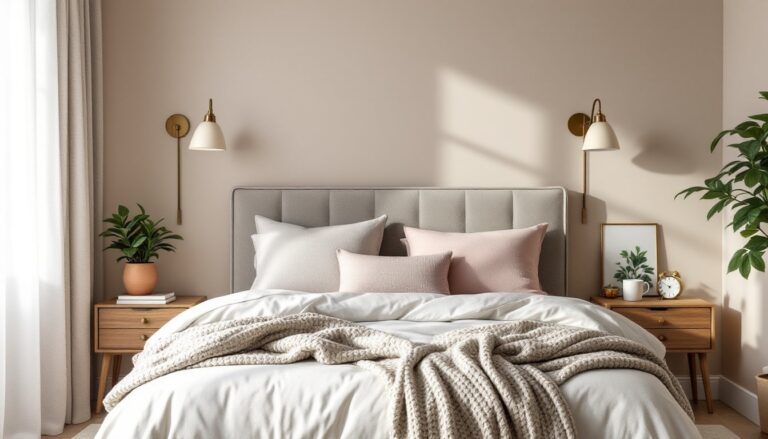
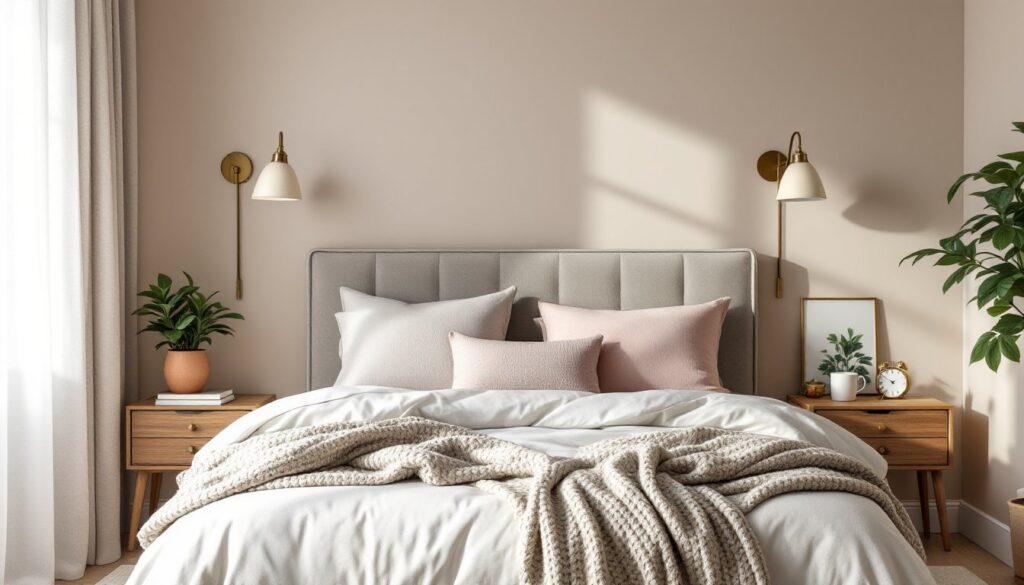
Bedding is where most of the tactile coziness happens. Start with a quality duvet or comforter in a warm white or cream, pure white can feel too stark against grey. Layer with a chunky knit throw blanket at the foot of the bed (cable knit or oversized waffle weave in oatmeal, camel, or soft blush tones).
Pillows should vary in texture: linen euro shams, velvet lumbar pillows, maybe a faux fur or boucle accent pillow. Avoid going overboard, six to eight pillows max, or the bed becomes a staging hassle.
For upholstered furniture (headboard, bench, accent chair), choose fabrics with visible texture: linen, bouclé, or channel-tufted velvet. A grey linen headboard with natural wood nightstands balances cool and warm. If the headboard is wood, add an upholstered bench or chair in a soft grey fabric to bring in that textile element.
Lighting Strategies That Enhance Grey’s Warmth
Lighting can make a grey room feel cozy or cold, it’s that critical. The color temperature of bulbs is measured in Kelvins: 2700K–3000K is warm white (slightly yellow), while 4000K+ is cool white (bluish). For grey bedrooms, stay in the 2700K–3000K range across all light sources.
Layered lighting is non-negotiable. One overhead fixture isn’t enough. Install a dimmer switch on the overhead (easy DIY if it’s a standard single-pole switch, turn off the breaker, remove the old switch, connect the dimmer per the instructions, typically black wire to black, white to white, ground to ground). Dimmers let occupants adjust warmth and intensity throughout the day.
Add bedside table lamps with fabric shades, metal or glass shades cast harsher light. Lamps should be proportional: for a standard nightstand (24″–28″ tall), use lamps 24″–27″ tall so the bottom of the shade sits at about mattress height when seated.
Wall sconces flanking the bed (hardwired or plug-in) free up nightstand space and add ambient light. Swing-arm sconces are functional for reading. If hardwiring, they should be centered about 60″–66″ from the floor to the center of the fixture, and 8″–12″ out from the side of the headboard.
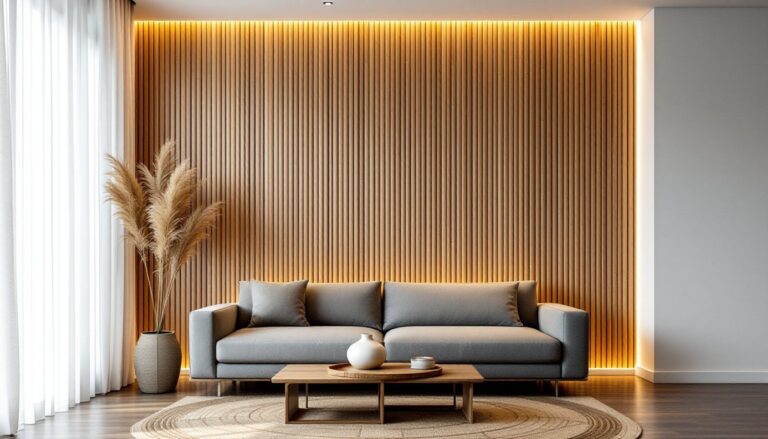
Consider a floor lamp in a corner with a soft glow bulb or Edison-style filament for ambient warmth. String lights or LED strips behind the headboard (warm white only) add subtle backlighting that makes the grey walls glow rather than flatten.
Natural light should be maximized but controlled. If privacy allows, keep window treatments open during the day. For evening, blackout options are important, grey rooms rely heavily on artificial light after dark, and streetlights or exterior lights bleeding in can wash out the cozy effect.
Adding Natural Elements and Accent Colors
Natural materials warm up grey instantly. Wood tones, especially walnut, oak, and lighter pine, contrast nicely with grey walls. A wooden bed frame, floating shelves, or a reclaimed wood accent wall behind the bed (easy DIY with 1×6 pine boards, stained and mounted horizontally with construction adhesive and finishing nails) adds organic warmth.
Live plants break up the monochrome. Snake plants, pothos, or fiddle leaf figs thrive in bedrooms with indirect light. Use ceramic or terracotta pots rather than plastic, they add another texture and earthy tone.
Accent colors should be warm and muted. Burnt orange, terracotta, blush pink, soft sage, or warm mustard work well in pillows, throws, or artwork. For ideas on blending pink and grey in bedroom design, explore combinations of warm blush tones with cooler greys.
Metal finishes matter too. Brass, bronze, and matte gold fixtures (drawer pulls, lamp bases, curtain rods, picture frames) read warmer against grey than chrome or brushed nickel. Swap out builder-grade chrome hardware, it’s usually just screwed in, so switching to brass knobs or pulls takes minutes per piece.
Artwork and decor should include warm tones or natural subjects. Black-and-white photography can look sharp but doesn’t add warmth. Instead, choose prints with warm color palettes, or frame botanical prints, landscapes, or abstract pieces with rust, ochre, or cream tones. Large-scale art (at least 2/3 the width of the furniture below it) has more impact than a gallery wall of small frames.
DIY Grey Bedroom Decor Projects You Can Tackle This Weekend
Several cozy-grey upgrades are manageable DIY projects that don’t require a contractor or major tools.
Accent wall with peel-and-stick wallpaper or paint: If the room is all one grey, add depth by making the wall behind the bed a shade darker or adding a textured peel-and-stick wallpaper in a subtle pattern (linen-look, grasscloth texture). Peel-and-stick goes up in a few hours, measure the wall, cut panels with a utility knife and straightedge, apply from top to bottom, smoothing as you go. For inspiration on layering textures and modern interior design ideas, consider how pattern and depth create visual interest.
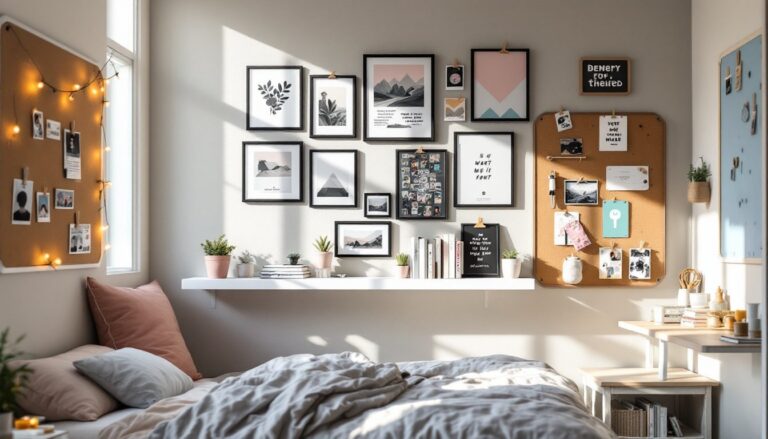
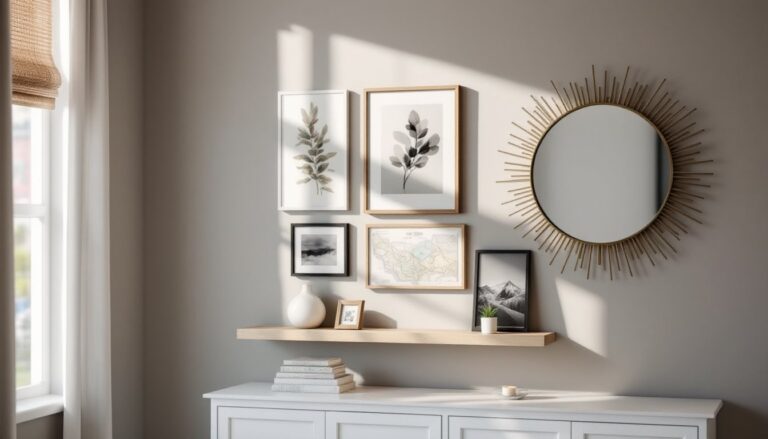
Floating shelves: Add two or three staggered floating shelves (1×8 or 1×10 boards, 36″–48″ long) on an empty wall. Use heavy-duty floating shelf brackets rated for at least 30 lbs. Find studs with a stud finder, level and mount brackets, slide boards over brackets. Style with plants, books, and small decor.
DIY upholstered headboard: Build a simple headboard from 3/4″ plywood cut to size (48″ wide x 36″ tall for a twin, 72″ wide for a queen), 2″ foam padding (cut to match with a utility knife or electric carving knife), and fabric (linen or velvet, about 2 yards for a queen). Wrap foam and fabric around the board, staple to the back with a staple gun, and mount to the wall with French cleats or heavy-duty picture hangers. Total cost is often under $80.
Swap out lighting fixtures: Replacing a basic overhead light or outdated lamps updates the room instantly. For hardwired fixtures, turn off the breaker, disconnect the old fixture (usually just wire nuts connecting black to black, white to white, ground to ground), and install the new one following the same connections. Most bedroom fixtures weigh under 10 lbs and don’t require additional bracing.
Stencil or hand-paint an accent pattern: For a subtle decorative touch, use a large-scale stencil (damask, geometric, or botanical) in a slightly darker or lighter grey than the wall color. Secure the stencil with painter’s tape, dab paint with a foam roller or stencil brush (don’t overload, less is more), and repeat across one wall. This adds pattern without the commitment of wallpaper.
Custom curtain rods: Upgrade basic rods to ceiling-mounted versions using 1/2″ or 3/4″ galvanized pipe and floor flanges from a hardware store. Spray paint them matte black or brass, mount flanges to ceiling joists or with toggle anchors in drywall, screw in pipe, and hang curtains with clip rings. The ceiling mount makes the room feel taller and more finished. Resources such as room styling and decor guides offer additional methods for transforming bedroom aesthetics on a budget.
Each of these projects is completable in a weekend or less and makes a measurable difference in how cozy and intentional the space feels.