
Table of Contents
ToggleSunflowers aren’t just for gardens anymore. Their bold, cheerful presence translates remarkably well to interior spaces, offering warmth and personality without the maintenance of live plants. Whether someone’s tackling a complete room refresh or just looking to break up a stretch of blank drywall, sunflower wall decor delivers instant visual interest. Unlike trendy motifs that fade fast, sunflowers have staying power, they’re recognizable, universally liked, and work across design styles from farmhouse to contemporary. This guide walks through what makes sunflower decor effective, explores popular styles and materials, covers a few DIY build options, and explains strategic placement for maximum impact.
Key Takeaways
- Sunflower wall decor works across all design styles because its strong silhouette and warm yellow tones create an eye-catching focal point without overwhelming the space.
- Metal sunflower sculptures, canvas prints, and DIY wooden projects each offer distinct aesthetic and practical benefits depending on your room type, budget, and desired maintenance level.
- Proper placement is essential: hang sunflower art at eye level (57–60 inches from the floor) above furniture, positioned to span two-thirds to three-quarters of the width below it.
- Strategic spacing matters in gallery arrangements—keep metal pieces 3–4 inches apart and leave 6–12 inches between furniture tops and artwork bottoms to maintain visual balance.
- DIY sunflower wall decor projects like wooden wall hangings or paper wreaths are beginner-friendly alternatives that allow customization for awkward wall spaces and renter-friendly solutions.
Why Sunflower Wall Decor Works in Any Room
Sunflower decor succeeds where other florals stumble because of its strong silhouette and warm color palette. The contrast between deep brown centers and vibrant yellow petals creates a focal point that draws the eye without overwhelming a space. Unlike delicate pastels or busy patterns, sunflowers read clearly from across a room.
From a design standpoint, yellow sits on the warm end of the spectrum, it reflects light well and can make smaller rooms feel more open. Pairing sunflower pieces with neutral walls (grays, taupes, soft whites) lets the artwork pop. They’re equally at home against darker accent walls, where the golden tones provide relief from heavier hues.
Sunflower motifs also carry positive associations, growth, optimism, summer, which makes them particularly effective in spaces where people gather. Kitchens, dining rooms, and entryways benefit from that upbeat visual cue. They’re forgiving, too: a single large piece works as a statement, or a clustered arrangement of smaller sunflower elements can fill an awkward wall section without looking cluttered.
Unlike some decorative themes that demand specific furniture or color schemes, sunflowers adapt. They complement wood tones naturally (think of rustic frames or reclaimed barn wood backing), but they also pair well with metals, especially oil-rubbed bronze or matte black finishes. That versatility means homeowners won’t need to overhaul a room to make sunflower decor fit.
Popular Sunflower Wall Decor Styles to Consider
Metal Sunflower Art and Sculptures
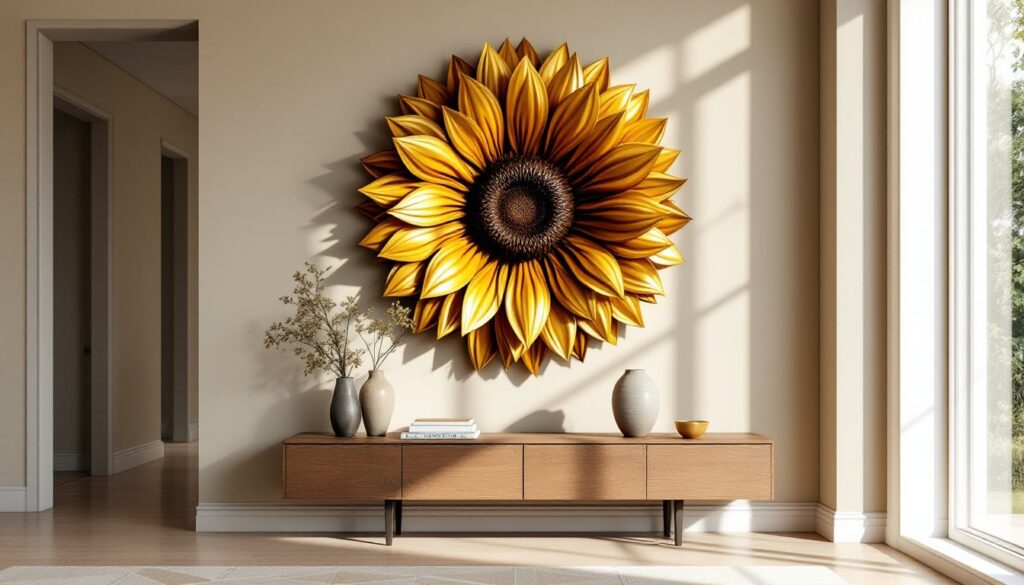
Metal sunflower pieces range from laser-cut steel silhouettes to hand-forged wrought iron sculptures with dimensional petals. Powder-coated steel resists rust and holds color well, making it suitable for covered outdoor spaces or high-humidity rooms like bathrooms. Look for pieces with layered petals, they cast interesting shadows when wall-mounted and add depth that flat cutouts can’t match.
Three-dimensional metal sunflowers often come as wall-mounted sculptures with stems and leaves that extend several inches off the wall. These work best on walls with minimal trim or obstacles: they need breathing room. Mounting typically requires toggle bolts or wall anchors rated for the piece’s weight, metal art can be deceptively heavy, often 5-10 pounds for a 24-inch diameter piece.
For a cohesive gallery wall arrangement, mixing metal sunflowers with other textures (wood, canvas) creates visual variety. Stick to a consistent finish, all matte black or all antique bronze, to keep the grouping from looking chaotic. Spacing pieces 3-4 inches apart maintains individual impact while reading as a unified display.
Canvas Prints and Framed Artwork
Canvas prints offer the most variety in artistic style: photorealistic closeups, watercolor interpretations, abstract representations, vintage botanical illustrations. Giclee prints on canvas provide better color accuracy and longevity than standard inkjet prints, especially in rooms with natural light exposure. UV-protective glass or acrylic glazing extends print life further, though it adds cost.
Framed artwork brings structure and formality. A floating frame (where the canvas sits slightly forward of the frame molding) adds a contemporary edge, while traditional frames with matting suit classic or farmhouse interiors. For DIY framers, standard canvas sizes, 16×20, 18×24, 24×36 inches, make finding off-the-shelf frames simpler and cheaper than custom work.
Many homeowners overlook the impact of frame width. Thin frames (0.75-1 inch) keep focus on the image itself, while wider frames (2-3 inches) add substantial presence and work better on large walls. When hanging multiple framed pieces, maintaining consistent frame style matters more than matching artwork styles. Three different sunflower prints in identical black frames will look more intentional than three matching prints in mismatched frames.
For placement, canvas and framed pieces should hang with centers at eye level (roughly 57-60 inches from the floor). In dining rooms where people are seated, drop that measurement by 6-8 inches. Hanging too high is the most common mistake, pieces end up floating near the ceiling instead of relating to the furniture below.
DIY Sunflower Wall Decor Projects You Can Make
Building custom sunflower decor isn’t complicated, and it allows for exact sizing to fit awkward wall spaces. Here are two approachable projects.
Wooden Sunflower Wall Hanging
Materials needed:
- 1×6 pine boards (actual dimensions 3/4″ × 5-1/2″), length depends on desired flower size
- Wood glue and 1-1/4 inch brad nails
- Circular saw or miter saw
- Sandpaper (120-grit)
- Yellow and brown acrylic paint or wood stain
- Sawtooth hanger
Cut the 1×6 into petal shapes, tapered rectangles work, roughly 8-10 inches long. For a full sunflower, twelve to fifteen petals create good coverage. Arrange petals in a circle, overlapping slightly at the base, and glue them to a circular backing cut from 1/4-inch plywood (an 18-inch circle works well for 10-inch petals). Secure with brad nails from the back.
Cut a second, smaller circle (6-8 inches) for the center. Sand everything smooth, splintery edges kill the finished look. Paint petals yellow, the center brown or black, and let dry completely before mounting the center piece. Attach a sawtooth hanger to the back plywood circle with screws, not nails: nails pull out under the piece’s weight.
Paper Sunflower Wreath
For a lightweight, renter-friendly option, paper crafting techniques provide flexibility without power tools. This project suits kitchens or covered porches where weight and weather resistance matter less.
Materials:
- Cardstock in yellow, brown, and green (65-110 lb weight)
- Hot glue gun
- 14-inch grapevine or wire wreath form
- Scissors or craft knife
Trace and cut petal shapes from yellow cardstock, aim for 40-50 petals in varying sizes for dimension. Curl petal tips slightly by wrapping them around a pencil. Cut 3-inch circles from brown cardstock for flower centers. Assemble flowers by gluing petals in overlapping layers around the brown centers, building up three or four layers.
Create five to seven flowers in different sizes, then attach them to the wreath form with hot glue, clustering them on one side rather than distributing evenly. Fill gaps with cut leaves from green cardstock. The asymmetrical arrangement looks more organic than a perfectly balanced wreath. Hang with a Command hook rated for 3-5 pounds, overkill for paper, but the adhesive holds better than the 1-pound version.
Where to Place Sunflower Wall Decor for Maximum Impact
Strategic placement amplifies sunflower decor’s effectiveness. Random placement wastes its potential as a focal point.
Above Furniture Pieces
Hanging sunflower art above a sofa, bed, or console table creates a clear relationship between furniture and wall decor. The piece should span two-thirds to three-quarters of the furniture width below it. A 72-inch sofa pairs well with art or a grouping measuring 48-54 inches wide. Anything narrower looks tentative: wider risks visually overwhelming the furniture.
Leave 6-12 inches of space between the furniture top and the artwork’s bottom edge. Less than six inches makes the piece feel like it’s sitting on the furniture: more than twelve inches disconnects them. For rooms with modern interior design elements, this proportional relationship maintains visual balance without strict symmetry.
Kitchen and Dining Areas
Kitchens benefit from sunflower decor on walls opposite windows, the yellow tones bounce light around the room. Avoid placing art directly behind stovetops or ranges where grease splatter becomes an issue. Metal pieces clean more easily than fabric or paper-based decor in these zones.
In dining rooms, position sunflower pieces where seated guests can enjoy them without craning their necks. The wall opposite the table’s long side works better than the short ends, which often get blocked by chairs or servers.
Entryways and Hallways
Narrow spaces amplify the impact of bold decor. A single large sunflower piece (30+ inches) commands attention in an entryway without cluttering the space. In hallways, consider a vertical arrangement of smaller pieces rather than a traditional horizontal gallery, it emphasizes ceiling height and feels less cramped.
For entryways with high ceilings, don’t let artwork float too high. Even in two-story foyers, keep the center of the main piece within the 57-60 inch guideline. You can add secondary pieces higher up, but the primary visual anchor should relate to human scale.
Staircase Walls
Staircase walls present a challenge because the floor elevation changes. Rather than leveling pieces horizontally (which looks off as you climb), arrange them following the staircase angle. The bottom edge of each piece should maintain consistent spacing from the stair treads, usually 7-9 inches. This creates a rising diagonal that feels intentional. Many contemporary home showcases demonstrate this ascending arrangement in stairwell galleries.
Use a level to ensure each individual piece hangs straight, what you’re angling is the overall grouping, not the pieces themselves.
Conclusion
Sunflower wall decor delivers reliable visual impact without demanding a complete room redesign. Whether someone opts for metal sculptures, framed prints, or tackles a DIY build, the key is matching scale to the space and placing pieces with intention rather than default center-wall positioning. The projects outlined here require basic tools and moderate skill, nothing that would intimidate someone comfortable with a miter saw or hot glue gun. Start with one well-placed piece and build from there if the wall can support more.